
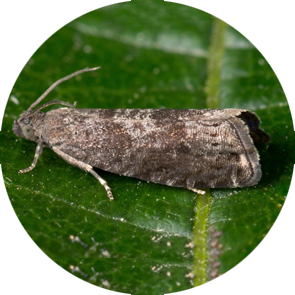
| Nom latin | Grapholita funebrana |
| Nom commun | Plum fruit moth |
| Biologie | Adult moths are active at night and lay eggs on the undersides of plum tree leaves or on fruits. The larvae bore into plum fruits, forming tunnels within the fruits; the infested fruits either drop prematurely or turn red early. They produce 2-3 generations per year, overwintering as mature larvae by spinning cocoons in the soil. |
| Dégâts | This pest primarily damages plum trees but can also harm apricot and cherry trees. |
| Régions de distribution | Europe |
| Surveillance | Pheromone lures mimic natural sex pheromones to attract male insects into specialized traps for population monitoring and suppression. As a core IPM component, monitoring enables early risk detection and targeted control. Mass trapping reduces mating opportunities to curb offspring populations. Protocols: ●Use only with matched traps. ●15-45 traps/hectare,replace/replenish every 4-6 weeks. ●Wear gloves or wash hands with detergent when switching lure types. ●Refer to trap-specific hanging instructions. |
| Pièges recommandés | Delta Trap, Wing Trap |
Partagez vos coordonnées pour recevoir des solutions à phéromones adaptées avec précision. Si notre portefeuille existant ne propose pas la solution optimale, notre équipe de chimie de synthèse lancera un développement sur mesure – de la conception de la structure moléculaire à la production à grande échelle.
