
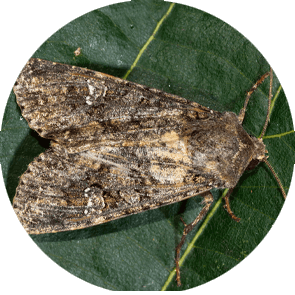
| Nom latin | Mamestra brassicae |
| Nom commun | Cabbage moth |
| Biologie | Adults are nocturnal and strongly attracted to black light traps and sugar-vinegar solutions, laying eggs in clusters on the undersides of leaves. Larvae are polyphagous with 6 instars: young larvae cluster to feed, while older larvae disperse to cause damage, chewing holes or notches in leaves and even gnawing on leafy heads. This pest is prevalent in spring and autumn, posing a significant threat to Brassicaceae vegetables. |
| Dégâts | This pest primarily damages cruciferous crops such as cabbages, Chinese cabbages, radishes, and rapeseed. |
| Régions de distribution | Eurasian temperate regions |
| Surveillance | Pheromone lures mimic natural sex pheromones to attract male insects into specialized traps for population monitoring and suppression. As a core IPM component, monitoring enables early risk detection and targeted control. Mass trapping reduces mating opportunities to curb offspring populations. Protocols: ●Use only with matched traps. ●15-45 traps/hectare,replace/replenish every 4-6 weeks. ●Wear gloves or wash hands with detergent when switching lure types. ●Refer to trap-specific hanging instructions. |
| Pièges recommandés | Delta Trap, Wing Trap |
Partagez vos coordonnées pour recevoir des solutions à phéromones adaptées avec précision. Si notre portefeuille existant ne propose pas la solution optimale, notre équipe de chimie de synthèse lancera un développement sur mesure – de la conception de la structure moléculaire à la production à grande échelle.
