
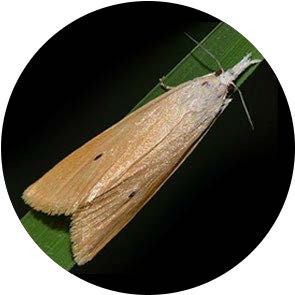
| 학명 | Chilo suppressalis |
| 일반명 | Spotted borer |
| 생태 | Adults are nocturnal with weak phototaxis, laying eggs on rice leaf sheaths or blades. Larvae bore into rice stems, causing "dead sheaths," "dead hearts," and "white panicles." Compared to the tropical strain of Chilo suppressalis, it is better adapted to temperate climates, completing 2–4 generations annually with mature larvae overwintering in rice stubble or straw. |
| 피해 | This pest primarily damages rice but can also harm wheat, corn, and other crops. |
| 분포 지역 | East Asian rice-growing regions |
| 모니터링 | Pheromone lures mimic natural sex pheromones to attract male insects into specialized traps for population monitoring and suppression. As a core IPM component, monitoring enables early risk detection and targeted control. Mass trapping reduces mating opportunities to curb offspring populations. Protocols: ●Use only with matched traps. ●15-45 traps/hectare,replace/replenish every 4-6 weeks. ●Wear gloves or wash hands with detergent when switching lure types. ●Refer to trap-specific hanging instructions. |
| 추천 트랩 | Delta Trap, Wing Trap, Moth Trap |
연락처를 남겨 주시면 정밀하게 매칭된 페로몬 솔루션을 받아보실 수 있습니다. 기존 포트폴리오에 최적의 제품이 없을 경우, 당사 합성화학 팀이 분자 구조 설계부터 규모화 생산까지 맞춤 개발을 시작합니다.
