
China's National Agricultural Technology Extension and Service Center (NATESC) issued technical guidance on August 17, 2026 after its national crop-pest monitoring network indicated a renewed risk from rice planthoppers in southern rice regions. The guidance said the pest complex was about to enter a peak period of nymph hatching.
The dated report covered rice areas across southern China while crops were at different growth stages: much of the middle-season rice was in the middle-to-late grain-filling period, and late rice ranged from peak tillering to jointing and booting. NATESC called for earlier intervention, regionally coordinated management, and close attention to both light-trap catches and field populations.
Thresholds turn monitoring data into field decisions
NATESC's August 17 guidance set a treatment threshold at about 1,000 planthoppers per 100 rice hills. It advised treatment once field density reached or approached that level. For fields at or above 3,000 insects per 100 hills—the large-occurrence threshold—the guidance gave priority to triflumezopyrim as a single agent, while also describing other treatment options for relevant situations.
These figures are decision thresholds, not a general count for every field in southern China. Local scouting remains necessary because crop stage, pest development, and field density differ by place. The guidance specifically placed light-trap and field monitoring at the center of decisions, calling for teams to track population changes and time interventions to the nymph-hatching period.
An earlier NATESC risk notice dated August 12 provides the scale behind that warning. As of August 9, national rice planthopper occurrence had reached 116 million mu-times. NATESC described this as broadly level with the five-year average and 10% below the ten-year average. The source uses an accumulated area-occurrence measure; it should not be read as 116 million unique mu of infested land.
Migration, weather, and brown planthopper dominance
According to the August 12 notice, continued rain and the outer circulation of Typhoon Bai Du Hai combined with migration and reproduction within fields. NATESC reported a marked tendency toward severe or outbreak-level occurrence in parts of Jiangnan and the middle-lower Yangtze rice region.
Brown planthopper, Nilaparvata lugens, dominated reported light-trap catches. Its share was 82–92% in southwestern South China and Jiangxi, and 50–70% across western Jiangnan and most of the middle-lower Yangtze. NATESC described a stable dominant population with overlapping generations and an outbreak risk. The EPPO Global Database records the species under code NILALU. White-backed planthopper, Sogatella furcifera, is another component of the monitored rice planthopper complex and is recorded by EPPO under code SOGAFU.
The geographic percentages are snapshots from a dated surveillance report. They do not establish the species composition of an individual field, nor do they show that population structure will remain unchanged. Species identification and current local counts are therefore important inputs to any monitoring or control decision.
Light traps provide an early-warning signal
NATESC reported provincial average cumulative catches of 6,000–10,000 insects per monitoring point in Guangxi, Hainan, Jiangxi, and Hunan. Several named monitoring sites recorded more than 5,000 insects in a single night. Those observations led plant-protection agencies to strengthen light-trap monitoring and field surveys and to issue short-term forecasts and alerts.
Light-trap totals are valuable for tracking migration and population change, but they are not interchangeable with field density. The guidance keeps both evidence streams in view: trap catches help reveal movement and changing pressure, while counts per 100 rice hills connect conditions in a field to the stated action thresholds. A monitoring program should preserve that distinction when setting objectives, sampling schedules, and alert rules.
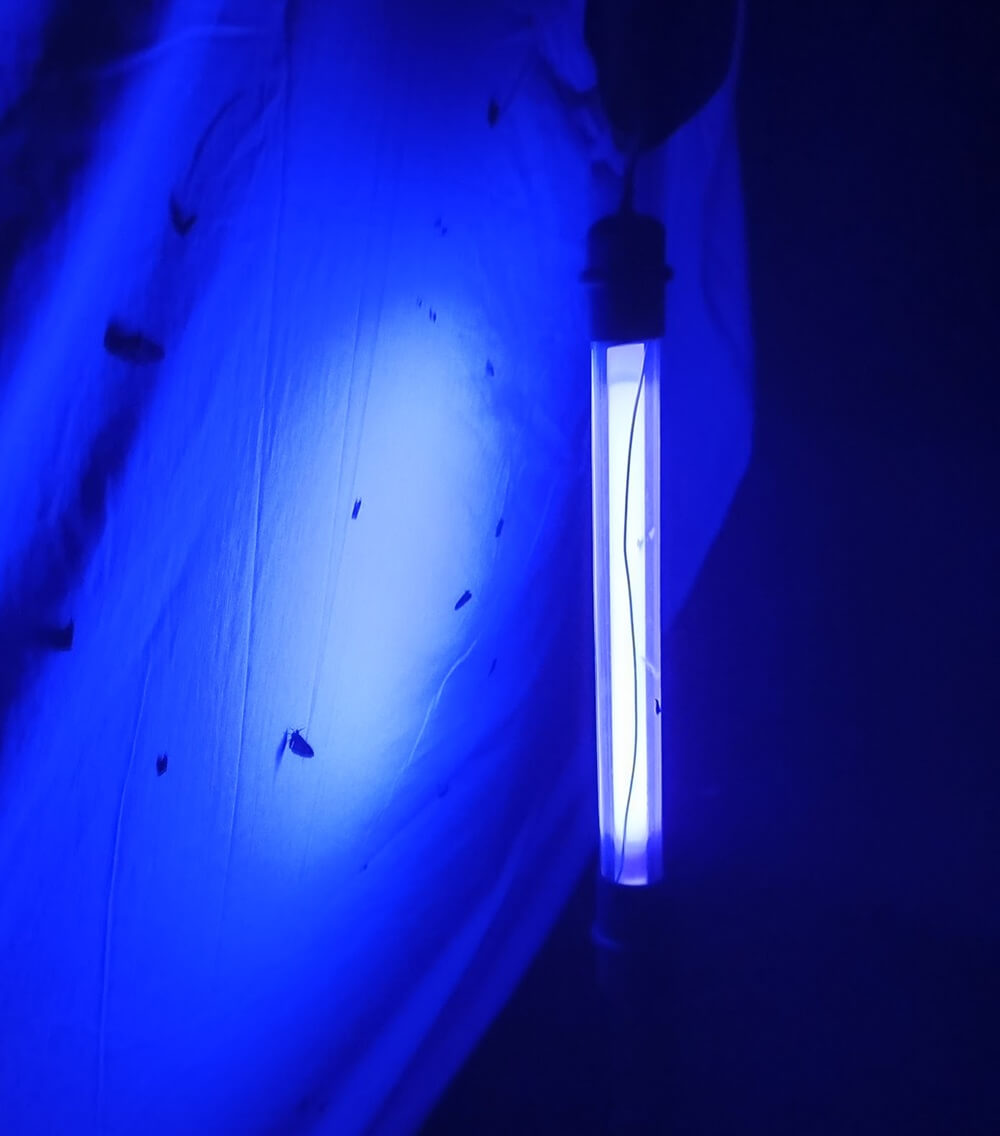
The hero image illustrates an active light trap used to survey nocturnal insects. It is contextual and does not show a rice planthopper or a specific NATESC monitoring site. It should not be used for pest identification or as evidence of the equipment deployed in the reported program.
A capability-led path for species-specific monitoring development
ECOPHERO's catalog does not list Nilaparvata lugens, Sogatella furcifera, Laodelphax striatellus, or a Delphacidae planthopper genus as a target pest. This article therefore does not claim a catalog product, a CAS-matched lure, a registered use, or a field-proven solution for rice planthoppers.
For teams investigating a semiochemical component within a broader monitoring program, ECOPHERO can support semiochemical literature review, candidate pheromone or attractant synthesis inquiry, analytical verification, lure formulation and dispenser optimization support, and monitoring-program design and field-validation coordination. Each step would need a defined species, geography, crop stage, monitoring objective, and comparison method.
That development work should complement—not replace—the official light-trap surveillance, field scouting, thresholds, and control guidance described by NATESC. Candidate lures or attractants would require analytical assessment and field validation under relevant rice-growing conditions before any conclusion about performance. Results for one planthopper species, location, or crop stage should not be assumed to transfer to another.
A useful project brief would identify the confirmed target species, the intended role of the monitoring tool, current trap and scouting methods, deployment timing, field layout, and criteria for success. Those inputs allow literature, candidate chemistry, dispenser work, and field-validation planning to address a specific operational question rather than imply an off-the-shelf solution.

