
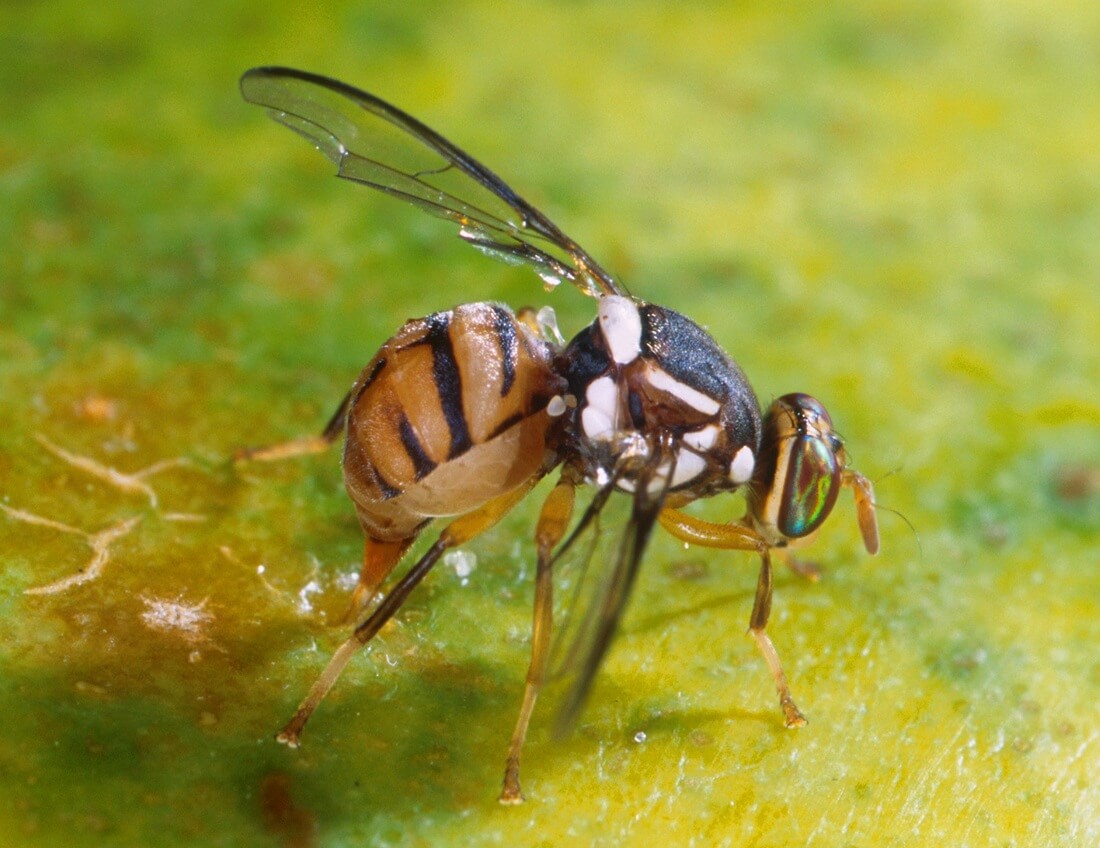
On March 23, 2026, USDA APHIS and the California Department of Food and Agriculture removed the Oriental fruit fly (Bactrocera dorsalis) quarantine in Riverside and San Bernardino Counties, California. The NAPPO Official Pest Report identifies the area as the Jurupa Valley quarantine and reports that the action released 131 square miles from quarantine, including 10 acres of commercial grape production. Release occurred after three generations had elapsed since the date of the last OFF detection, based on a degree-day model.
That makes the report more than an administrative update. It shows how official surveillance and response programs can change quarantine status when detections stop for the required biological interval. For fruit fly programs, the endpoint depends on knowing whether the pest is still being detected in the field, which makes reliable detection tools central to decision timing.
Why it matters
The EPPO Global Database lists Bactrocera dorsalis under the common name oriental fruit fly and describes it as one of the most polyphagous fruit fly species, recorded from close to 450 hosts across 80 plant families. EPPO also notes that transport of infested fruit is the main means of movement to previously uninfested areas. In commercial and residential fruit-growing regions, that biology is why official programs treat detections seriously: fruit movement, regulated articles, and market access can all become part of the response.
The California report reflects that risk. APHIS had restricted interstate movement of regulated articles from the Jurupa Valley quarantine area to prevent spread to non-infested areas of the United States. The removal of the quarantine on March 23, 2026, therefore marked a practical change for the regulated area as well as a plant-health milestone.
How male lure monitoring supports response
EPPO states that males of Bactrocera dorsalis are efficiently attracted to methyl eugenol, while both sexes can also be monitored with traps baited with protein-based attractants. For methyl-eugenol-responsive fruit flies, male lure trapping helps surveillance networks detect activity, focus follow-up inspection, and track whether detections continue after control measures begin.
At higher deployment intensity and with locally approved toxicant systems, methyl eugenol is also used in the male annihilation technique (MAT), a lure-and-kill approach. Exact lure format, trap density, timing, and field deployment parameters should be validated locally; they should not be treated as universal values across crops, geographies, or regulatory programs.
The ECOPHERO solution
For Oriental fruit fly surveillance and male annihilation programs, ECOPHERO supplies Methyl eugenol (1,2-Dimethoxy-4-(2-propenyl)-benzene) (CAS 93-15-2). It is matched to Bactrocera dorsalis for male annihilation and monitoring traps.
- Active: Methyl eugenol (1,2-Dimethoxy-4-(2-propenyl)-benzene) (CAS 93-15-2)
- Mode: Lure & kill (MAT)
- Application: Male annihilation / monitoring traps
The role of the active is straightforward: attract responsive male flies so a program can detect activity, focus inspections, and, where locally validated, support lure-and-kill tactics. It is not a stand-alone substitute for official quarantine rules or field protocols. It is one semiochemical input within a surveillance-and-response system.
How monitoring supports decisions
The NAPPO report says the quarantine was removed only after three generations had elapsed since the last Oriental fruit fly detection. That detail matters because surveillance is not just about finding the first insect. It also supports decisions over time: whether a response area still has detections, whether regulated areas need to remain in place, and when an official program has enough evidence to change quarantine status.
For a pest with broad host associations and trade relevance, the value of monitoring is the detection record it creates. Male lure traps give response teams one way to keep watch for Bactrocera dorsalis activity and to connect field observations with regulatory decisions.
ECOPHERO capability
ECOPHERO manufactures pheromone and semiochemical active ingredients for projects ranging from gram-scale development to ton-scale custom synthesis. If you are working on Oriental fruit fly surveillance, Bactrocera dorsalis response planning, or methyl eugenol procurement, contact us with the pest name or CAS number for a quote. Please include Methyl eugenol or CAS 93-15-2 so our team can confirm specification, lead time, and synthesis scale.
Sources
- NAPPO Official Pest Report: Bactrocera dorsalis (Oriental Fruit Fly): APHIS Removes Quarantine Area in California
- EPPO Global Database: Bactrocera dorsalis overview
- EPPO Datasheet: Bactrocera dorsalis
- Image credit/license: ECOPHERO generated original, CC0 — https://creativecommons.org/publicdomain/zero/1.0/
